Monday, May 18, 2009

Molecular Spring and Chip Scale Dominoes

Think of the various energy storage media. There are countless types. Some involving mechanics, some chemicals, and some far more exotic, yet they all share one thing in common... the ability to hold energy and release it as needed. However, not all methods are equal. A typical method signifying the efficacy of the great spectrum of methods is the energy capacity per kilogram of mass.

Since ancient times, springs were the method of choice for compact portable devices requiring some source of power. Once wound up and let loose, a spring will attempt to revert to it's unwound state, which is the spring's lowest energy level. As this process occurs, the energy which was stored in the metal windings produces a force capable of performing work such as driving a pendulum clock, launching a catapult, cranking an electric turbine, etc.

But just how efficient are springs? Well, assuming a primarily steel construction, a spring can, at best, only contain about 300 joules of energy per kilogram. This could power a 60 watt light bulb for 5 seconds, but due to the limitations of efficient mechanical work to electricity converters, even 5 seconds would be pushing the limits. If one needs more energy, one would be forced to use more steel. If one kilogram seems small and you're thinking that 300 joules / kg is pretty impressive, consider the fact that a one kilogram lithium ion battery can easily hold 500,000 joules, enough to power that same light bulb for over 2 hours.

Looking back at the spring now, the cause for it's extremely poor energy density has it's roots in the fact that there is significant friction between each molecule of the steel. While a spring may possess the mass of one kilogram, the majority of the atoms it contains are not contributing to the overall capacity. It's simply not built to. If the atoms could be assembled one by one into long polymer chains, there would be virtually no friction at all. Think of a molecule of water. If you could some how pull on one of it's hydrogen atoms and slightly displace it further away from the oxygen atom, and then let go, what would happen? As it turns out, this is an example of a molecular spring. The energy potential is created due to an atom being in an energized state and naturally desiring to return to it's ground level. Friction is primarily a macroscopic epiphenomenon, and when dealing with the torsion of atoms in a molecule, there are no frictions to interfere. Constructing a one kilogram spring one atom at a time would be a monumental feat, however would it be worth it? Possibly. Such a spring would be able to put the lithium ion battery to shame, easily outperforming it by a factor of 20. A 1 kilogram molecular spring could power a laptop computer for weeks, rather than hours and could be recharged nearly infinitely, having very little internal degradation, very much unlike the usual chemical cell batteries.

Impressive as it sounds...of course, nothing can compare to the impossibly perfect energy storage capacity of pure matter / antimatter reactors. Apparently the power source of choice for the USS Enterprise in the world of Star Trek. One kilogram of such material could harness the required energy to effortlessly propel an automobile down the highway at 65 miles per hour, fuel gauge worry free, for over 8,000 years. The only precaution: Avoid crashing. The reactor would likely be compromised and part of the planet would vaporize.

Sunday, February 8, 2009

A Price for the Sun


Although the Sun does not generate a uniform amount of light throughout it's life and will continue to slowly brighten until it's death, about 5 billion years from now, we can still roughly estimate how much light will be produced between now and it's end and determine, in terms of energy costs, how much it would likely set one back to buy the Sun.

5.6216744275618786699008 X 10^40 joules of energy will be released in the form of light, by the Sun, in the next 5 billion years. Only one billionth of that energy will actually impact the Earth, so if our future successors require more energy, they might consider building a Dyson Sphere around our star.

This amount of eventual energy leaving the Sun can be converted to kilowatt hours (kWh) which registers:
1.561576229878299630528 X 10^34 kWh
If I were to expend this much energy at my home in the next month, the electric company would bill me approximately 2.1081279103357045012128 X 10^33 dollars, which although not very accurate for an estimate, people of today could reasonable expect to pay this, if the Sun were for sale.

I once heard that the combined sale price for everything on the surface of the Earth would be 1.0 X 10^15 dollars. That's quite a difference.

Slowly Going Green


I bought a 1 watt solar panel for 30 dollars, tie wrapped it to the end of a long PVC pipe with T connector end, sharpened the other end into a point with a hacksaw, and finally drove it 1 foot into the ground in my backyard, where it will tap the sun's free energy and supply power to my small battery / inverter setup.

Considering that the assembly produces only 1 joule per second and there is only 12 hour sunlight exposure per day (multiplied by the squareroot of two divided by 2 - to obtain the average intensity), only 30,547 joules per day of energy are extracted. Now also, assuming that the price for electricity is currently 13.5 cents per kilowatt hour (in my area) or 1 cent for 266,667 joules, the solar panel would have to gather sunlight for about 71 years before the enough money was saved to justify paying the 30 dollar panel price. Since 71 years is far beyond the expected lifespan of my radiant energy to electricity converter, no profit will ever be provided.

The lesson?... Do not buy 1 watt panels for 30 dollars. While there are much better solutions out there, such as more space efficient models, higher wattages, and longer functional lifetimes, they still seem to be too expensive for the majority of us energy users. Apparently, 60% efficiency has been developed but isn't readily available at the moment and also requires a more intense light source to reach it's peak performance.

Since 130,131,352,486,171,736 watts of sunlight are available on Earth at any particular moment, sunlight will inevitably become our primary source of energy.

Sexual Reproduction


Presently, thousands of processor intensive generations are required to amount to even the most modest variation in survival instincts. A proposed solution, sexual reproduction, stolen directly from the biological world, might allow a remedy. Sex, which is the process of mixing and recombining of multiple individuals' genetic construction codes, could substancially improve the efficiency of the Evolution Machine Experiment by helping to expand diversity between generations and spread advantageous traits, while simultaneously preventing the propogation of negative attributes.

In principle, gender differences are not required for the process of sex, however due to differences in selection pressure between the genetic sending and receiving sides, sexual dimorphism is likely to develop. It is offen incorrectly thought that a sexually reproducing species always consists of two modes - male and female. However, without dimorphism, there would be only one type and in more unusual instances of life on Earth, occassionally there are organisms that effectively have three or more genders. By adding such mechanisms into the experiment of evolution, new behaviors will emerge, such as genetic information sharing and possibly sexual rejection if the artificial organism perceives it's potential mate as incompentant.

Thursday, January 29, 2009

Abiognesis in a Bottle

Unfortunately, even with the fastest personal computers available, a large amount of resources are required to conduct experiments involving evolution. In the current implementation of the Balanced-Force Evolution Machine, 30 Avoiding cells compete against 30 Attacker cells, with the former attempting to minimize being shot by the Attackers' cannons and the latter doing the opposite. The average duration of a generation is set to approximately 25 seconds and at the time of this writing has achieved 600 generations on my AMD quad core. Notable advancements in group behavior are beginning to appear as illustrated to the left. To minimize damage inflicted upon them, the Avoider cells appear to be hiding in the corner. The cells on the outside of this cluster are protecting those within and periodically appear to swap places. As intuitive as this might sound, it is a remarkable adaptation considering that all of these cellular robots were originally conceived completely absent minded. After a few weeks of running this simulation, I suspect far more impressive behaviors to emerge. At the moment, all we can do is wait.

Monday, January 26, 2009

Balanced Forced Evolution

This experiment involves the interaction between two mutually capable artificial organisms and has been derived from the algorithms of my first open ended evolution machine. Each "cell", fitted with a 1Mhz brainfuck compatible processor with evolution capabilities, steering control, thrusters and decelerators, one dimensional "laser" scanners for vision, and an optional gun, compete to either maximize their kill points or minimize death points. The two classes, Avaiders and Attackers, respectively have essentially opposite goals. While their mechanics and strength are all exactly equal and forever locked "as-is", they each will inevitably evolve different strategies and behaviors to maximize their survival instincts. A simple user interface is provided so the experimenter can peer within their minds, to see through their eyes, examine their genetic information and lineage, and monitor statistics of the current and past generations of success with both graphs and history charts. Ultimately these groups of beings of opposing forces, may form coalitions to better their odds. It's not as simple as survival of the fittest, as was once suggested. There is in fact, many factors involved, and too many variables to have ever been intuitively known. The attempt of this experiment is to not only reveal evolution's secrets, but to force the two competing sides into an ever advancing race for dominance. As the opposing force advances, the other team will either be destroyed or succeed in a beneficial mutation. A control factor within the simulation, is to disallow death by reverting to a previous generation, in other words, to basically allow the losing side to try again with a possibly more effective solution. The end result is uncertain, but certainly might promote intelligent behavior and possibly the beginnings of a self aware entity.

Friday, January 16, 2009

Cellular Grid Rechargeable Batteries

One of the primary disadvantages of rechargeable batteries is the expended time required to recharge them and the necessary process used to ensure continued long life. Since extremely rapid recharges, by use of high voltage, have the tenancy to generate irregularities in the battery's cells' electrodes, current regulation is a critical function of reliable regeneration of today's batteries.
A possible remedy involves breaking down the battery into a matrix of hundreds or thousands of micro cells. These miniaturized chemical cells could be recharged more reliably at high speed and each cell could be controlled individually by the use of multiplexing circuitry. In the same way that a memory chip is divided into bytes and each byte can be randomly accessed non sequentially, this high tech battery could be designed to automatically scan through the cells which needed a recharge and skip those which didn't. Even more importantly, each cell could be recharged depending on it's own internal status, eliminating the possibility of damage to the battery as a whole. With a microprocessor controlled system, the battery could self organize, on demand, to produce the desired current and voltage output, without any losses associated with the problems of voltage regulators. Battery life, percentage charged, and charge cycles remaining could be measured with accuracy far exceeding anything ever seen before. The possibilities are endless.

One Instruction Set Computers


The logical extreme of reduced instruction set computers, as previously briefly mentioned in this article, is the use of a single parametrized op-code. To properly put this into perspective, modern x86 architectures, like the computer you are likely using now, and other CISC (complex instruction set computers) use hundreds, if not thousands, of individual instructions. The use of so many different commands within the processor forces the design to be very complex and leads to an increased chance of glitches and ultimately reduces maximum clock speed.

On the other hand, a reduced instruction set computer architecture (RISC), especially the one instruction set version (OISC), involves minimal circuitry inside the actual processor, simplifying the design and allowing components to be placed in a smaller area to enhance the speed by reducing propogation delays and latencies.


The model under investigation here is known as "Subtract-and-Branch-If-Less-than-or-Equal-to-Zero", symbolized as "subleq", and coded with no opcodes - since with the use of a sinlge op-code, the computer will not require explicit knowledge of what is expected, the opcode is implied and memory space is saved. Subleq takes three parameters, also known as operands, marked a, b, and c. The basic, and only, function of this code is to set the value at b equal to b minus a. In otherwords, b = b-a. For those that are not familar with typical assignment operators used in computer programming, the way this statement is evaluated is by taking the current value of whatever b-a happens to be. This value is then stored in and overwrited to, "assigned to", the value of b... meanwhile no change is made to a. IF the new value at b is less than or equal to 0 then program execution is "jumped" to the location held by paramter c, or more simply, the processor's program counter is set to the value of c. If a jump is not required you can't simply say 0 for c, since that would cause the program to reset and start over, 0 is the starting point for a program counter (typically). It is generally accepted to leave the third parameter c blank in these cases, which informs the processor that regardless of the previous operation, just go to the next instruction. It's still a jump, but only by one unit. Alternatively, the user can simply write in the location of the next instruction, it's exactly the same.

There are many ways to implement this design and slight modifcations are possible to create new instruction sets. Since program lengths can become extraordinarily long in such an instruction set, it can also be beneficial to add specialized hardware to the processor to allow multiplication or other mathematical functions to be performed in a single cycle. However, for proof of concept, the OISC mentioned here, is capable of universal computation! All with only one instruction.

If you've never run across such a claim before, I don't expect you to immediately understand how to program in this machine language. It's interesting that, at this point, you know everything about this one instruction set computer and yet, at the same time, probably wouldn't have any idea where to begin creating a program to drive it.

Well, here's a start, to perform addition of two numbers on this computer, all you have to do is...
    ADD a, b == subleq a, Z
subleq Z, b
subleq Z, Z
Good luck OISC programmers!

Saturday, January 10, 2009

Accelerometers - MEMS by Analog Devices


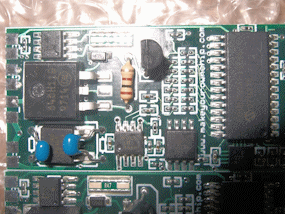
The picture to the left is the ADXL322 double axis accelerometer with analog output lines, a close variant to the triple axis version used within Nintendo's Wii video game console. The PCB on which it is shown mounted is only a break out board and has the necessary capacitors to determine the IC's samples per second rate. These easy to use and easy to solder modules typical cost around $30 USD. However, if your soldering skills are sufficient, you'd be much better off buying the accelerometer alone for as low as $3. With the rapid decline in price on these micro engineered machines, hobbyists and businesses everywhere are taking advantage of the benefits these tiny devices can provide.
These accelerometers, with sampling speeds of over 1000 times per second, can be used to directly measure dynamic acceleration and the static acceleration of gravity which can be mathematically converted to terms such as velocity, position, oritentation, jerk, and G force. With the variety of different calculations that can be performed all from this single chip, it is easy to realize a vast variety of different machines and devices such as digital hourglasses, computer pointing devices, degree of impact sensors, free fall sensors (especially important if you drop your laptop), Star Wars type lightsaber toys, image stablization for binoculars, telescopes, and cameras... the list is endless. A single chip such as this, can provide all of the sensors within a single package for a fully capable self driving car, since extrapolation of even position can be somewhat accurate, but more importantly, speed and impacts can be known, without the need to count wheel rotations and hope the wheels didn't skip, nor wire impact sensors 360 degrees around the chassis. If triple axis is desired, the ADXL330 is a very well known and widely available model to provide just that. Several other versions can provide PWM outputs, instead of analog, for easy integration with a digital microcontroller. So, please go buy some of these devices and build something amazing, and let me know how it turns out.

Wednesday, January 7, 2009

Self Driving Automobile - Version One Point Zero


To simply press a button and expect your car to safely and flawlessly drive itself and its occupants to a destination still seems far off in the future. To navigate an innumerable possible obstructions, law variations, and unpredictable human behaviors in surrounding traffic nearly requires an impossibly complicated set of instructions and algorithms far too vast for today's processors. At least, this is the current consensus of most artificial intelligence researchers. However, new methods of machine learning, pattern recognition, object avoidance, path finding algorithms, and prediction mechanisms just might make this dream a reality.

To achieve this possibility, I have developed a simple experiment, involving a reduced risk environment. After all, placing one's own vehicle in jeopardy is both financially and morally dangerous. Instead, an inexpensive radio controlled model car will suffice, of course deprived of its internal radio receiving circuit. In it's place, an advanced learning processor will assume total control over the vehicle's movements. Enhanced by a network of proximity sensors, accelerometers, and a 360 degree VGA camera which can be rotated to the CPU's desire, the learning machine will explore it's world, learning the causal relationships between events such as approaching wall and an immanent collision. Under self control, the car is able to exceed normal operating limits with high speed 20 volt sprints, rear differential locking, and dynamic electronic breaking to perform the otherwise impossible maneuvering for quick escapes from the difficult to predict real world variables.

Rather than using a neural network the processor will emulate a virtual system which is capable of open ended evolution. Much of my previous involvements in this approach are explained in prior postings within this blog. In essence, this virtual system will be coded by a genetic sequence. Since nano technology and auto assembly is currently beyond most hobbyists' budgets, this car will not have any replication, repair, or homeostasis abilities, so with respect to most definitions it will not be considered alive. However, possibly more importantly, it's mind - the virtual system being emulated by the car's processors, will be capable of self organization and full blown open evolution, affected directly by the natural laws of natural selection. This means, basically, that it's "brain" can be physically changed (within it's virtual world), not only it's software, but also it's hardware. The genetic sequence which encodes the construction of the automaton's mind is to be stored within a 4GB Flash card, which in theory is enough to hold the entire human genome.

Since open ended evolution can be aimless at times, I have decided to add directives to the processor which controls the virtual evolution experiment. It is important to understand the levels of abstraction involved with this device, so I will straight forwardly reiterate. The car is physical and it has a physical processor and physical sensors. The processor, however, generates a virtual computer through a process called emulation. It is that virtual computer that sees through the sensors and drives the car. The physical processor will supply some parameters to the evolution experiment, such as collision results in death and therefore whatever specific genetic code was running at the time is a failure. Performance will be ranked and behaviors such as object avoidance, trajectory prediction, and camera pattern recognition will emerge. The system will be rewarded for exploring larger areas, requiring greater accuracy of the vision system to avoid impacts while traveling. Unlike GM's supposed claim of a self driving car, this machine would be capable of learning, limited only by cheap memory, and would never require human intervention.

The evolutionary process, taking the car from a system which doesn't understand the visual input at all to an expert driver, could potentially take several years to complete. It would be taught rather than programmed and the algorithms generated by this selection effort could be utilized in a wide variety of useful tasks which one day may be combined in a more advanced design to safely and reliably transport the world's population to their destinations in fully automatic, self aware vehicles.

Wednesday, December 31, 2008

One Bit Manipulation - A Reduced Instruction Set Computer


The esoteric computer programming language, brainfuck, a reduced instruction set language and slight variation of p prime prime, uses a set of only eight instructions to perform universal computation. In otherwords, it can perform operations equivalent in complexity to any other computer, regardless of the fact that most modern processors use instruction sets consisting of several thousands of commands. Brainfuck uses basic operations to control both it's program counter and it's one and only memory pointer. By moving the memory and program pointers back and forth and incrementing and decrementing the values contained within up and down with conditional control, the limited language is capable of solving any algorithmically expressable problem. The 8 instructions are:
+ (increment value at pointer)
- (decrement value at pointer)
> (move pointer right)
< (move pointer left)
[ (jump forward to the matcing "]" *they can be nested if value at pointer is zero
] (jump backward to the command after the matching "[" if the value at the pointer is non zero
. (output the value at the pointer)
, (accept an input and store it in the location pointed to by the pointer)

Although this set may seem already maximally reduced, it can be decreased further! Firstly, the input and output commands are completely unnecessary. They simply provide a convenient method of transfering data between the processor and the external world. Other methods exists, such as memory mapping, and because of this, they can be eliminated.

On top of that, the brainfuck language assumes that the registers comprising the memory locations are 8 bit, however 8 bit wide registers are not necessary and reducing them to the logical extreme of only one bit allows for the + and - commands to be reduced to a single instruction. Since incrementing or decrementing a 1 bit value simple reverses the current value, for example ones turns to zeros and a zeros turns to ones, only one command is necessary and so for purposes of this article we can express it as "x", meaning to flip the current bit.

With this modified language, constructed from only 5 opcodes, one can create an even less efficient way of solving any problem. Is it possible to reduce the instruction set even further? Actually, surprisingly, the answer is yes. By the inclusions of more complicated internal architecture and addition of parameter based operations, the instruction set can be reduced to only one instruction. This impractical system doesn't do much more than to illustrate the methods by which a single instruction computer can work, however, it greatly reduces the quantity of transistors required to fabricate the processor and assuming that one day transistor switching times are reduced sufficiently, it could very well become cost effective.

Superior Digital Design

The design of the impossible is now in your hands. Allow us to professionally and affordably develop your advanced electronic computerized super invention. We offer software development, microcontroller programming, digital electronic circuit design, high power electronic controllers, artificial intelligences, and just about anything else. Designs for $300, if they're simple. You may never know if you don't request a free quote.


Monday, December 29, 2008

Genetic Error Correction Mechanism

What I've learned, through experimentation with open ended evolution by computer simulation, is that evolution will take a random path towards no particular goal as long as reproduction remains successful. If, however, there is an added parameter to maintaining survival, a particular evolutionary response (linear on average) will result. In extraordinarily simple self replicating machines, the process is nearly immediate, since it is necessary, but in more advanced systems, there is a great deal of redundancy and seemingly dormant code can "reactivate" to allow the organism to persevere. Also, interestingly, it is very common for complementary pairs of "genetic" code to form which each disallows the other from mutating. It is only when both of these is coincidentally mutated in the correct way that either of them can be changed successfully. This is a very natural, very common process, which acts as an error correcting mechanism very similar to that of a checksum.

Of course in my experiments there is no actual genetic code, meaning there is no DNA, however there is a code and that code is capable of mutation. I assume that essentially the natural laws of evolution and processes of natural selection can be governed by a universal mathematical description and for any system, regardless of material composition, the same will apply.

I'd like to hear from people about this, if anyone has had similar results with experiments. Also, if there are any readers out there that would like to take advantage of some of my source code for the universal open ended evolver please leave me a message. Thanks!

Persistance of Vision

Interesting, low part count, relatively simple devices, called Persistence of Vision displays, utilize the exceptionally slow response time of the retina to optical variations. Exploiting these effects make it possible to build a graphical matrix display with far fewer light emitting pixels than one might first intuitively expect. For example, this first picture illustrates my attempt of a hand built rotating POV clock without the need of any specialty machining tools. Using only seven LEDs, a 0.1 Horse power AC electric motor, 16Mhz microcontroller, and a solidly constructed aluminum frame, a virtual seven by 120 pixel display appears to come into existance. Electric power is supplied to the rotating circuit board by an isulated rotary contact and spring brush. The motor's rotor provides the necessary grounding connection and reduces the otherwise increase in friction that would result with a second brush. Alternative methods for supplying power to the board are numerous and probably would result in a quieter, longer lived design. Of these variations, the the simplest, quietest, and possibly least electrically efficient is to use an air core resonant transformer. This method consists of a primary coil mounted stationary to the motor which induces an electromagnetic field upon a secondary coil which travels with the rotating display platform providing a contactless power bridge to the control circuitry.

Since the display contains only minimal LEDs and weight is a factor, resolution can be improved simply by a faster control circuit and finer pitched bulbs. With LEDs spaced closer together and with the ability to control them more precisely, the designer can create images with better quality without resorting to spending extra money. Some have taken this concept to the extreme and produced full HD quality video using only about a 1000 emitters. Since rotation speed directly affects picture quality, it is important to minimize system components and mass. An aerodynamic design or placing the device in a vacuumed chamber can greatly improve refresh rates.

Rather than rotating the light source, a specially angled type mirror can be used to automatically reflect the light source into scanning rows upon a projection screen. The motor simply spins this 7 sided cylindrical mirror (each side having a slightly different tilt). When a stationary mounted laser is bounced off the rotating mirror a raster pattern is produced on the screen. By keeping track of rotational indexes and other timing information, a processor can determine whether to turn the laser on or off at extremely high speeds. The end result is the stable illusion of an image on the wall.

A still better approach is to use a flat mirror on a double axis, spring suspended mount. Electromagnets can force the mirror into a scanning pattern where rows are generated more often than columns. Very similar to a television's electron beam control, but far superior in its ability to project images beyond a vacuum chamber and zero requirement for a phosphorescent doped screen, a mechanically scanned laser projector can generate images of any size, with any resolution, and is only limited by the intensity of the laser's beam and the reaction speed of the electronics.

Atomic Time Receiver Circuit - Break Out Module

This is the CMMR - 6P - 60 receiver module. With minimal external hookups like power, and ground, and that's about it... this module forms a complete system for acquiring and digitizing the 60khz atomic clock radio broadcast from Colorado. By connecting its single digital output into a microcontroller and orienting the ferrite core antenna in the direction of the transmitter, the user can immediately take advantage of ultra precise official world time. Assuming you also know your exact location, the timing information retrieved could even be compensated for the fact that light travel is not instantaneous. The information contained within the signal encodes, either directly or indirectly, hours, minutes, seconds, month, day, and year. As well as, daylight savings time mode, leap year, and leap second. The time specified is in GMT (Greenwich Mean Time) Since the decoding of the timing pulses and time formatting may be difficult for those with limited experience, we offer a small module to supplement the features lacking within the CMMR and automatically handles resynchronization, error correction (since nearby electronics easily overcast the Colorado radio station), and power saving. Our module is microprocessor controlled and can easily interface with new and existing designs through a three wire interface. Unlike the CMMR by itself, the microcontroller controlled module assembly automatically decodes day of year into week, month, and day of week, eliminating the user's need to calculate this or use a lookup table. The picture to the right represents a simple clock based around the module. Upon power up, the system immediatelyy synchronizes the clock and periodically rechecks to prevent the possible drift of precision, since the US atomic clock is many orders of magnitude more precise than a typical quartz crystal.


Received Atomic Time from Colorado, United States version


Friday, December 26, 2008

A Game of Life, Multicored, Ultra Processor


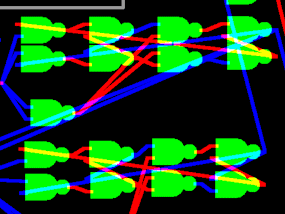
Conway's Game of Life, a system where each cell's value depends on both it's current state and it's neighbors, is the most popular cellular automaton ever created. It has been mathematically proven to be capable of universality, meaning basically within the rules of the game, any algorithmic process can be simulated and solved, given enough time and space. As the dimensions of the grid expand, conventional linear computers (like a desktop) have difficulties evaluating successive time steps within a reasonable amount of time. A possible solution to this problem is to create linkable hardware based modules, each with their own processor, which when combined could process exceedingly complicated scenarios. Given enough space, one could simulate entire computer systems or even neural networks like the human brain. Packed with a high enough density, a cellular automata based system could conceivably act as the ultimate multicored computer, literally consisting of possibly millions of individual processors. Unlike convention computer designs, there is no centralized instruction decoder in a CA based processor, nor any centralized memory. If one module malfunctions, the rest of the system will continue to run. Larger assemblies of modules would directly lead to more computing power and would be limited only by propagation delays in communication between modules. Trivial modular Game of Life circuit boards are readily available from various sites. These forms were only intended as a graphical excitement - something to be attached to a wall as a decoration. While primitive, they properly illustrate the essential concept of the idea. Lacking high refresh rates and being extraordinarily large and expensive for the computing power they could provide, one would have difficulties attempting to compile these devices into a working virtual world. In our laboratories, here at Nova Conceptions, we are working on high density / high speed versions which could form the basis of a multicored network of super processors, as well as the most awesome rendering of a graphical Game of Life simulation ever performed. I will post results as events progress.


Saturday, December 20, 2008

An Infinite Regression - Thoughts About Existance

Imagine the universe to be non continuous and the calculus to represent only an

approximation. Space and time are discrete units which have a lower limit in size and can assume only a finite set of properties and be arranged in a numerable set of possibilities. In this mindset the cosmos is a cellular automaton where the future is computable and the laws of physics are exactly determinable. Of course these ideas are controversial and there are discrepancies with many of the interpretations of quantum physics. Many experiments

seemingly clearly reveal the hidden variable theories to be inadequate explanations and belong in the realm of metaphysics – that which attempts to explain why physics is the way it is, w

hich may be an indeterminable. However, it is obvious by analogy that the universe very well could operate as a cellular automaton and whether or not this idea is provable, many interesting correlations can be extracted, including possible reasons why we may never know.

The Game of Life, a simple two dimensional cellular automaton which exhibits complex interactions and has been shown to be capable of universal computation has many similarities to our own world. Various types of machines can assembled within this cellular automaton, such as gliders, which are so common, they are naturally occurring within the system. Other machines

are sufficiently complicated that a natural origin for their existence could only be reasonably explained by evolution or, in the far more common case they are preprogrammed by the humans running the simulation, such as a complete universal computer. Since a computer is a machine

which can emulate any other algorithmic solving machine, it is as powerful as any other computer, at least in terms of computability. However probable or not, our universe may be being emulated through a computer built within a cellular automaton operating by The Game of Life rule set.

It is important to realize any implication for the specialness of the Game of Life is non existent and it was only used as an example. A cellular automaton of any number of dimensions, which is capable of performing universal computation, is capable of emulating another system which could be our universe. This means that physical laws around us are not necessarily meaningful in describing the true mechanism used to process this univer

se. In fact, the nested depth of emulation could be infinite, meaning essentially there could be no beginning to the process. This approach requires no confrontation to the question of what ultimately began existence, it would simply be the product of an infinitely long series of simulations. This doesn't mean we are not real. The term has little meaning at all, since reality seems to consist of information alone.

With sufficient computer power it would be possible in principle to simulate another universe, most likely smaller than our own but not necessarily, which could give rise to self aware lifeforms which may ponder over their own existence, completely oblivious that they are being watched on a computer screen. As in most cellular automata, the mechanisms, or laws of physics, may not allow information passing between the simulation and the simulator. Those within the simulation would have no knowledge of the higher realm and nothing they could ever do or build could allow them access unless a process for doing so was explicitly part of the rules.

Examples of naturally occurring cellular automata have been found on Earth in certain types of crystals, the color patterns of animals, and the finger prints on our hands.

Although we may be a simulation within yet another simulation, it is not necessary to assume that these simulations were designed with purpose by an intelligent entity, although either view is plausible. In my opinion the universe is probably naturally occurring, is part of an infinite chain of other simulations, and is a direct example of a specific cellular automata rather than a program being evaluated linearly on a universal computer. If this is the case, a systematic search for our universe's rule set could be done and once found, would be of great importance to our understanding of what is and is not physically possible. Keep in mind however, that the stability of the physics we see around us is not a guaranty. There is no way of knowing if rules can be modified, either globally or locally. The quest for understanding is an infinite journey, keep your mind open.

Wednesday, December 17, 2008

Maximal Esotericism


Redundancy is an important aspect of any code which has intentions of evolving through natural selection. Imagine a program, for example, which performs a certain task such as generating a sequence of prime numbers. If such a program were written to be as small or efficient as possible, it is highly probable that any modification made to a single instruction would cause the system to malfunction and no prime numbers would be generated. Since evolution depends on the accumulation of beneficial random mutations of a program, the program must at least be partially tolerant of changes.

A simple solution to this problem is to construct the initial program in a reduced instruction set environment, such as the OISC. Having only a single parameter based command, this one instruction set computer has no need for explicit coding of the opcodes and programs can become extraordinarily long even to achieve relatively simple tasks. To move data from one register to another, a very important and commonly used operation which is typically executed in a single instruction cycle, requires four instruction cycles in OISC using the subtract-and-branch-if conditional statement. See the example below.

MOV a, b ==
subleq b, b
subleq a, Z
subleq Z, b
subleq Z, Z

With simple instructions being expanded in this way, the program as a whole has a greater toleration of occasional mutation and is now ready to perform a massive evolution attempt. A simple Tetris playing artificial intelligence, written in OISC, provides an interesting experiment. First, several thousand slightly different versions of the AI are automatically synthesized by a mutation algorithm. Obviously, a very large number of these different version will be malformed and will not succeed in playing the game. However, occasionally, some of these variants will have acquired an advantage and will out perform their cousins. A simple scoring procedure can be written to evaluate the effectiveness of different AIs and only allow those which perform better to make it to the next generation. The cycle repeats when those which succeed are then selected for mutation of several thousand new variants, each with different mutations. Eventually a high performance Tetris solving algorithm will emerge. The system as a whole can continue to evolve and seemingly learn to play better and better. With accumulation of millions of mutations the final result will be something completely alien to the original human generated algorithm. It may develop intelligence and even self awareness, anything it needs to play the game.

Human Body Fuel Efficiency


I am often asked personal questions regarding my performance as a human being. "What is your peak metabolic rate?", they ask... which happens to be 0.39 kilocalories per second or 2.2 Horsepower. Needless to say, I have difficulties maintaining this power level, I only consume between 5,500 and 7,000 Calories per day and am adversely affected by lactic acid accumulation.
With an energy storage capacity of approximately 115 kilowatt hours (or 28,000 1.5V AA batteries) and the complete lack of the sensation of pain, I potentially could traverse a distance of nearly 600 miles when fully charged and to top it off, I could achieve this with the equivalent efficiency of 190.4 miles / gallon (unleaded gasoline).

Saturday, October 25, 2008

Life at the Speed of Light


In the blink of an eye our lives will change. Our minds will effortlessly expend 35 joules of energy and electrochemically evaluate 33 trillion thoughts. We will seemingly aimlessly be propelled 65,000 miles into the future. For the vast majority of the population, there is no looking back.
We find patterns in the past and make sense of the previous. The future is distant and cannot be understood until it has arrived. The lives that surround us and interact with us have a greater impact than we can ever know.